
La Ñapa
In Spanish, la ñapa means a little something extra, and that’s what this page includes…things we think are of interest and worth sharing. Sometimes in English and sometimes in Spanish, we hope that you'll like what you find.
¡Que disfruten! And be sure to check out our other articles too.
-
Advice for a Healthy Brain and Body everyone should read this
-
El Paso del Yabebirí audio recording
While many believe that Spanish is indeed a romantic language, it is classified as one of the Romance language because its roots come mostly from Rome and Latin. Spanish explorers began to spread the language to Central and South America as well as some of North America in the 1400s. Today, Spanish is second only to Chinese in the total number of native speakers worldwide, numbering about 322 million. It is the official language of Argentina, Bolivia, Chile, Colombia, Costa Rica, Cuba, Dominican Republic, Ecuador, El Salvador, Equatorial Guinea, Guatemala, Honduras, Mexico, Nicaragua, Panama, Paraguay, Peru, Puerto Rico, Spain, Uruguay, and Venezuela.
Spanish is frequently spoken in the U.S. and not just by Hispanics. Aside from English, it is the most widely taught language in U.S., with more and more citizens are becoming bilingual or partly so. While there are plenty of differences between English and Spanish, there is more commonality than most people realize.
Things I learned from my dog - Lo que mi perro me enseñó
As all dog lovers know, a dog is about a lot more than feeding and walks. While dogs can't talk, they certainly communicate, and not just about how they feel or what they want. They show us a great deal through their actions. Here are three things my dog taught me, shown in English and Spanish. 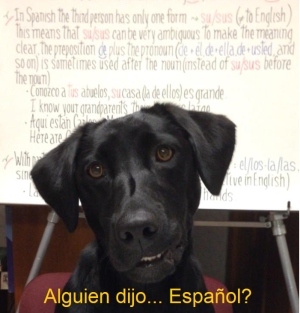
Always have hope. A tener esperanza siempre.
Be persistent when it counts. A ser persistente cuando vale la pena.
Forgive others when they do something they shouldn't.
A perdonar a los demás cuando hagan algo que no deban.
Well, of course there's more. Here are links to the full list of 20 lessons. If you have or have had a dog, these things will make sense to you.
Lo que mi perro me enseñó (Spanish)
Things I learned from my dog (English and Spanish)
Many Vermont dairy farms rely on Latin American workers, largely hidden from public view. "The Most Costly Journey" (El Viaje Más Caro) is a collection of  true stories about the challenges and experiences of these migrants, published in May 2021. According to Open Door Clinic, "Originally distributed to farm workers as individual Spanish language comic books, this collected edition brings the lives and voices – as well as the challenges and hardships – of these workers to an English-language audience, granting insight into the experiences and lives of the people vital to producing the food we eat." You can read the individual stories at https://opendoormidd.org/most-costly-journey/ and also find out how you can purchase the book. The stories appear in English, but you can read them in Spanish if you just change the website language choice to Español (upper right on the page). These stirring stories will provide a window into the lives of these immigrants in Vermont, so that we might understand them as the U.S. seeks to reform its immigration system.
Advice for a Healthy Brain and Body
This topic goes beyond what we usually cover. It's a "big picture" topic for us all, and you'll note that language learning is among the recommendations. Here we summarize an article by Dr. Daniel López Rosetti that appeared on March 8, 2018 in La Nacion, a well known Argentinean newspaper. For those who want to read that article in Spanish, click here to go to the web page.
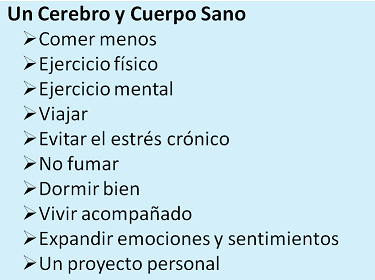
Is it possible to explain how to live a healthy life with a recipe of 10 recommendations? Perhaps you would add something to the list, but what Rosetti has to say is good advice worth sharing. To be sure, Rosetti's focus is on the brain, although he makes the point that brain and body health are inextricably linked. So, taking care of our emotional health is important to our overall health. After reading his advice, perhaps you will note a common thread: be mentally, physically and socially active. Here is a summary his recommendations. Certainly a full discussion of each could fill a book.
-
Eat less (Comer menos): Over-eating is bad for your brain; reducing your daily consumption of calories can improve neuron functions and their interconnections (synapses). This happens throughout the brain, but particularly in a structure called the hippocampus that plays an important role in memory and learning.
-
Physical exercise (Ejercicio físico): Exercise improves our cognitive abilities and emotional perception to such an extent that Rosetti refers to it as "cerebral fertilizer."
-
Mental exercise (Ejercicio mental): You want to continually challenge your brain with problem solving and learning processes, including learning a new language or another mental activity that keeps our cognitive abilities in shape. Retiring does mean you are retiring mentally.
-
Travel (Viajar): Traveling gets your out of your routine and that's good for mental functions. And, your exposure to new things stimulates your memory and creates positive emotions. Yes, even a small weekend trip counts.
-
Avoid chronic stress (Evitar el estrés crónico): Stress produces toxic substances in the body that damage brain function.
-
Don't smoke (No fumar): No surprise here. Among other things, smoking damages blood vessels feeding your brain, like a garden without enough water.
-
Sleep well (Dormir bien): While we sleep, our brain is working, throwing out the trash and organizing things that need to be remembered. Give it time to do its work.
-
Live accompanied (Vivir acompañado): Enjoy the company of friends; the emotional interaction enriches vital brain functions.
-
Expand emotions and feelings (Expandir emociones y sentimientos): The brain is a social organ and interpersonal relationships are important to our health. We need to pay attention to our emotions and feelings and be positive.
-
A personal project
(Un proyecto personal): Big or small, a project creates a goal for the future, is a stimulus and improve your mood. You can copy this little table and stick it up on your fridge or mirror. Learn the Spanish, exercise your brain and improve your overall health.
You can copy this little table and stick it up on your fridge or mirror. Learn the Spanish, exercise your brain and improve your overall health.
So How Do You Say "Face Mask" in Spanish?
In this period of the coronavirus, everyone is talking about face masks. If you are reading or  otherwise communicating about coronavirus in Spanish, you'll want to know the commonly used words for "face mask" in Spanish. Well before coronavirus appeared, lots of different kinds of masks and face or mouth protection existed for numerous purposes. So as you might expect, the associated vocabulary is diverse. However, the words we've included here are those you are likely to find used in reference to coronavirus facemasks. You may see or hear any of the following terms used in this context. Usage varies by region but is mixed.
una mascarilla - perhaps the most universally used term
una máscara - also common
un barbijo - used in Argentina and Bolivia
un tapabocas
un cubreboca, un cubrebocas
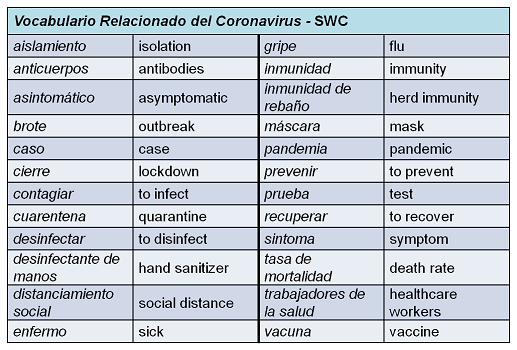
Talking About COVID in Spanish
Like it or not, we all seem to be talking a lot about COVID these days. At least there are more and more reasons now to be optimistic. If you are communicating in Spanish about the pandemic, you'll want to know a handful of the frequently used words -- so here they are. Many are similar to those in English ('coronavirus' and 'COVID' are the same in both languages). As is often the case, the vocabulary may vary by region or country or because there are synonyms. This is certainly true for 'mask' -- see our article So How Do You Say "Face Mask" in Spanish? We hope this helps you put some new vocabulary to use. Since we wrote this list, there is now a lot of talk about the "vaccination card" so we added that; it's "comprobante" in Spanish.
Farmers Markets - Los Mercados
Laura, one of our wonderful young students, wrote the following piece about farmers markets. She did such a good job, we had to share it:
En Vermont, la mayoría del año no hay mercados al aire libre porque hace mucho frío. Pero, en el verano cuando hay sol, los pueblos tienen mercados agrícolas. Los mercados siempre abren un día de la semana, pero el día depende del pueblo. En mi pueblo, es el jueves o el viernes. Nuestros mercados son lugares para socializar con otra gente, como los mercados de México y España, y también para apoyar a la comunidad. En nuestros mercados, puedes comprar comida caliente, frutas y verduras frescas, y artesanías locales. La mamá de uno de mis amigos tenía un puesto allí, y vendía miel y cera de abeja. A veces estos mercados tienen músicos locales también, que tocan la guitarra u otro instrumento durante el mercado. Me encantan estos mercados.
Cuando tenía doce años, visité Barcelona con mis padres, y fui a un gran mercado al aire libre. Mis primos nos mostraron todos los puestos diferentes, y me parecía como una carpa de circo gigante con muchos colores. Todavía puedo recordar todos los olores extraños, y especialmente el de las gomitas que mi primo me compró.
Aquí, no he encontrado ninguna tienda dónde puedas regatear el precio. Es posible que la gente aquí considere esto como malos modales. Si conoces al vendedor, quizás te de un descuento, pero nada más.
Students Pedro and Sol Were Very Different
Among the students that come to Spanish in Waterbury Center are both beginners and those who already know some Spanish. This is the story of Pedro and Sol, two fictional students who came to us with very different backgrounds in Spanish. Both were motivated to improve their Spanish and each had distinct strengths and weaknesses.
Pedro had some immersion experience, acquired through traveling. This opportunity to communicate in Spanish gave Pedro some level of comfort speaking and listening comprehension. However, Pedro never had a class in Spanish and had no idea about any rules of the language. Pedro learned from personal interactions "in the street" via listening and repeating. In these situations, the native speakers were polite and told Pedro he spoke very well, even if that wasn't exactly true. And when Pedro made mistakes, they smiled and didn't say a word. As a result Pedro became comfortable speaking. But, there was a downside. By patching things together, Pedro habitualized quite a few errors. And, Pedro had almost no idea about verb tenses or conjugation or other of grammar topics. Does that matter if Pedro can speak and understand what others say?
Pedro found that he was making errors that at times such that natives couldn't understand what he was trying to say. Worse than that, he would sometimes say something that had a very different meaning than what he intended, sometimes in a bad way. Most importantly, Pedro found that he was stuck at a fairly low level of proficiency because he did not know how the language is structured. He realized that he had to go back to the beginning and learn some grammar in order to advance. And he had to unlearn quite a few errors that he had become glued in his brain after repeated use. His comfort with speaking would serve him well but he had to step back and learn some basics.
Sol's background was quite different. Sol had had few opportunities to practice speaking and she wasn't very good at it. She felt embarrassed about making mistakes. However, she had taken classes and learned some grammar and fundamentals about how the Spanish language works. That gave her a foundation from which she could build her proficiency. She definitely needed more practice speaking and listening, but she was practicing what she had learned and putting the two together.
So what are the take-home messages from this story?
-
For adults, learning how the Spanish language works and starting to speak from the beginning is the preferred approach.
-
Speaking well requires a lot of practice, as does listening comprehension.
-
Making mistakes is a natural part of learning to speak a new language. A teacher can help you nip errors in the bud so they don't become bad habits.
-
Speak as much as you can. Use your Spanish in as many situations as possible, through speaking, reading, writing, and listening. Visiting a Spanish-speaking country is great, but there are other ways to immerse yourself in the language.
You can read more about these points in other articles found on our pages, Furthering Spanish Fluency and Tips for Learning Spanish.
In July 2018, Boston's national public radio station, WBUR, did a weeklong series on language called Speaking My Language. It included the following six radio interviews, each about 5-10 minutes long:
-
Why There's A Language Learning Gap In The United States
-
These Polyglots Have Tips For How To Learn As Many Languages As You Want
-
'You Have To Have Speed': What It Takes To Be A United Nations Interpreter
-
Translation Technology Is Getting Better. What Does That Mean For The Future?
-
Meet One Family That Speaks Greek, Swedish And English At Home
-
Your Questions About Language, Answered
The series is very well done and worth checking out. You can listen to each interview (play or download) or read the written summary on WBUR's website.
Here are a few excerpts…
From Marty Abbott, executive director of the American Council on the Teaching of Foreign Languages:
You're Not too Old to Learn a New Language
"You're never too old to start learning a language. We have a number of senior citizens interested in learning a language, because we know from the research that it wards off the degeneration of the brain, some of the Alzheimer's diseases. So we have a number of senior citizens eager to learn  languages for that reason. But we also know that no matter when you start, you can be a successful language learner. What happens with the younger children is that they still have the ability to be sound like a native speaker in another language. ... It's definitely a matter of time on task, so the earlier you start and the longer you stay with that language, the more proficient you become."
Google Translate
"For the language educator, a great tool, but one aspect that the language apps are never going to take the place of is understanding the perspective of the world through that language. And that's what you get by actually learning the language. We naively think that the rest of the world views the world the way we do. When you learn the language and …culture, …you really do understand the world from their perspective."
Learning Tips from Ken Loukinen, who recently moved to Colombia and commented on the series: "Nothing beats actual lessons, watching Spanish TV with English subtitles and making mistakes from trying."
This video (in Spanish) about "el Bio-Optico Organizado" is very well done, and shows one of the lastest reading systems. View video
Does your native language shape the way you think? Can you only see the world through the lens of your language and the words you know? If Eskimos have 50 words for snow, does that drive how they understand snow or is it more the other way around? 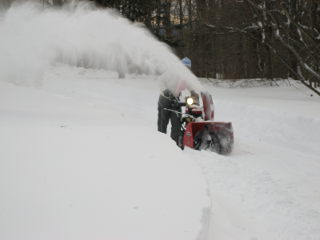
A new study looks at this long-debated topic by re-casting the question. Instead of asking whether speakers of different languages have different minds, they are studying bilinguals and asking if two different minds exist within one person. The daily news site of the journal Science reported on this study and generated a long list of reader comments. According to the research, knowing another language provides an alternate vision of the world, and a person's language affects their behavior. “If you’re a bilingual speaker, you’re able to entertain different perspectives and go back and forth,” says cognitive scientist Phillip Wolff of Emory University in Atlanta, who was not connected with the study.
In the book Man Without Words, author Susan Schaller tells of her experiences teaching a man who was born deaf and had neither a language nor even the concept of the existence of language. Clearly, he was able to think, and without words.
Compare the following statements in English/Spanish: "I am a lawyer" (Soy abogado) and "I am bored" (Estoy aburrido). In English, both examples use the verb "to be." In Spanish, each of these examples uses a different verb, in effect indicating that being bored is a temporary condition whereas being a lawyer is a lasting situation. In each instance, the Spanish verb signals a difference in the state or condition. That's relevant extra information, but if English is your native language, you were probably never confused about these statements.
Certainly language affects our thinking, but so do other things. Why not conduct your own experiment? Try learning another language and see what it does for your thinking and perceptions.
This piece, entitled "15 Differences between a Normal Friend and an Argentinean Friend," has been shared a lot online and the original author is unknown. It is both amusing and largely true.

We use the ñ (eñe) in our logo because this letter is unique to Spanish and of Spanish origin. It is pronounced like the letters ny in the word canyon.
We are pleased to share this audio recording based on one of the stories from 'Cuentos De La Selva' (Stories of the Jungle) by Horacio Quiroga. Our Advanced class collaborated to adapt the story text for audio presentation, and did a great job! In El Paso del Yabebirí, the protagonists are mostly animals that speak and think like humans. The story is told entirely in Spanish. If your Spanish listening skills are moderate or better, we think you will enjoy listening. The story is about 22 minutes long and the MP3 file is about 20 MB.
Play/Dowload El Paso del Yabebirí
These imaginative and whimsical short stories were written by our Beginning 3 students. They've progressed a great deal with their Spanish in a relatively short amount of time, and combined that with a lot of creativity!
-
Creo que estoy enamorado - autora Angela
-
Un americano que habla español - autora Abigail
Our small class groups often become tight knit. And so it is with our Advanced class. We are proud to present stories written by some of the students, as part of our study of Rosario Ferré's essay about Mary Shelley, the author of Frankenstein.
-
Ambición Sin Fin - autor El Predicador
-
Cortina de Humo - autor El Galán
-
El Cazador Reducido - autor La Sensata
-
El Dedo Gordo - autor La Vaquera
-
La Fantasma de Túnica y Capucha - autor El Hablador
-
Sin Huellas - autor El Científico
A group of our intermediate students did a great job on a poetry project, ¡Qué Falta Tú Me Haces! This phrase does not translate word for word, but means, “I miss you and lack something because you are not here.” We are proud to share the poems with you!
-
Tú Estuviste Aquí Recientemente - autor Sharon
-
¡Qué Falta Tú Me Haces! - autor La Alpinista
-
¡Qué Falta Tú Me Haces! - autor Sean
-
¡Qué Falta Tú Me Haces! - autor Katherine
This phrase is also the name of a popular song performned by many artists. Lyrics, song and video by Jennifer Lopez.
Our students have traveled to Argentina, Bolivia, Chile, Colombia, Costa Rica, Cuba, Dominican Republic, Ecuador, El Salvador, Guatemala, Honduras, Mexico, Nicaragua, Panama, Peru, Puerto Rico and Spain. Sometimes the road less traveled is the best choice. Help us complete the list!
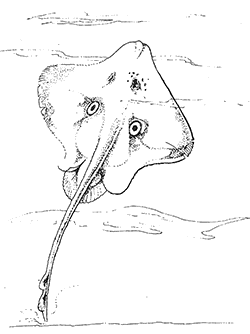
 Have you seen this horrible blood-sucking beast? The name comes from the Spanish chupar "to suck" and cabra "goat", or "goat sucker" since it commonly attacks goats.
The legend of " El Chupacabra" originated from Puerto Rico but has also been reported from Mexico, Chile, Brazil and parts of the U.S. This animal supposedly attacks livestock, which would be found dead, drained of blood with puncture wounds on the neck.
Animal Planet did a program about the legend (http://www.animalplanet.com/tv-shows/lost-tapes/creatures/chupacabra.htm), and a number of people have commented on the website about their personal sightings of the beast. Sightings in northern Mexico and the southern United States have been verified as dogs or coyotes afflicted by mange, which can leave them nearly hairless. This may well be the case for the alleged chupacabra recently captured in Texas (see YouTube video). But no one knows for sure if the Chupacabra really exists; maybe one could be lurking nearby.
Four Words that Sound Similar but Are Not
Do you know the meaning of the following four commonly used Spanish words?
-
la abeja
-
la arveja
-
la avispa
-
la oveja
They sound similar but their meanings are different. Below are four photos that correspond with the meanings of these words: wasp, sheep, pea and bee. The only thing is, they are not in the same order as the Spanish words listed above! You need to determine which photo goes with which Spanish word.




We have not included the answers here; if you need to look these words up, that will help you remember. If you don't know these words, make a sketch of each and then write the word in Spanish next to it. It doesn't matter if your drawing is terrible, crazy images are even better for helping us to remember. Give it a try!
Perhaps you learned about -AR verbs in learning verb conjugation; verbs that end with 'ar' that follow a particular pattern. Now we'll introduce three AG verbs -- nothing to do with conjugation but verbs you should know that begin with 'ag.' There are more than three but think of these as three you are likely to use a lot.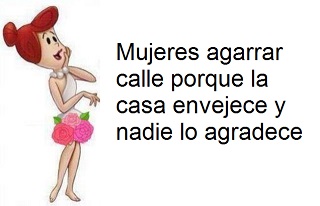
Aguantar - to bear or tolerate. Your clue to remember: sounds like 'gauntlet.'
Example: No puedo aguantar el calor -- I can't bare the heat.
Agarrar - to grasp or take hold of. Your clue to remember: almost sounds like 'grab.' Example: Ella agarró su cartera y se fue -- She grabbed her handbag and left.
Agradecer - to thank. Your clue to remember: the 'gra' in this verb is like gracias. Example: Yo te agradezco por todo -- Thanks for everything.
While only a handful of verbs in Spanish begin with the  letter Q, some are used quite commonly. We've listed 6 below that you should learn. Querer and Quedar are the most important. You'll want to start off with the more common uses such as in the examples, but be aware that all these verbs are used in quite a few different contexts with varied meanings. And, all can include a reflexive form. While this means there's more to learn, there is also a lot of power in these Q verbs.
Quebrar - to break
El niño se quebró su brazo derecho.
The child broke his right arm.
Note: The verb romper also means to break, but quebrar is used in the case of bones.
Quedar - to stay, to remain
Ella se quedó en la cama todo el día porque estaba enferma.
She stayed in bed all day because she was sick.
Esa camisa te queda bien.
That shirt looks good on you.
Note: "Quedar bien/mal con..." can mean to make a good/bad impression on someone.
Quejarse - to complain
Él se queja todo el tiempo de sus vecinos.
He is always complaining about his neighbors.
Quemar - to burn
Me quemé la mano en la concina.
I burned my hand on the stove.
Querer - to want, to love
Quiero comprarte un coche nuevo porque te quiero.
I want to buy a new car because I love you.
Note: the most commonly used Q verb that everyone needs to learn early on.
Quitar - to take away
Nosotros les pedimos a nuestra visitas que se quiten los zapatos cuando hay nieve.
We always ask our guests to take off their shoes when there is snow.